6G-RUPA 6G Recursive User Plane Architecture
A user plane for 6G mobile networks, built from one kind of layer repeated at every scale.
Mobile networks still carry user data with protocols that have remained largely untouched for almost 30 years. 6G-RUPA rethinks that part of the network using the Recursive InterNetwork Architecture (RINA), aiming for networks that are more flexible, scale better and use less energy.
Four systems from left to right: a phone (UE), a base station (gNB), a core gateway (UPF) and a server in the data network. The operator layer spans the UE, gNB and GUPF, and the gNB relays in it. Below it, a radio link connects the UE to the gNB, and a core link connects the gNB to the GUPF. The PDU layer, IP or Ethernet, runs on top from the UE to the server, and the GUPF relays in it. Each system relays in one layer at most.
- 6G-RUPA layers
- The same kind of layer at different scopes. The operator layer carries the phone’s traffic from UE to GUPF with one protocol, EFCP, where 5G splits the job between SDAP/PDCP on the radio side and GTP-U in the core. Beneath it, a radio link covers the hop to the gNB and a core link the hop to the GUPF.
- PDU layer
- IP or Ethernet, the connectivity applications see.
- Relay
- Where a system forwards: the gNB in the operator layer, the GUPF in the PDU layer. Each system relays in one layer at most. Understand how this works.
- Existing links
- Whatever radio, transport and data-network technology is already in place.
News
Poster Presentation at SNS4SNS in Sophia Antipolis
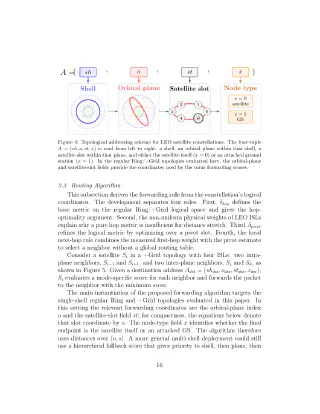
We presented a poster at SNS4SNS (Sophia Antipolis) on rethinking NTN routing with 6G-RUPA for scalable, energy-efficient LEO networks.
LEOPath Released: An Open-Source LEO Routing Simulator
We published LEOPath, a Python-based simulation framework to analyze and compare routing algorithms in LEO satellite constellations.
Research Stay at Boston University Fall Semester 2025
Spending a semester at BU working with Professor John Day and the team on 6G-RUPA and RINA.
6G-RUPA Initial Position Paper Published in MDPI Computers Journal
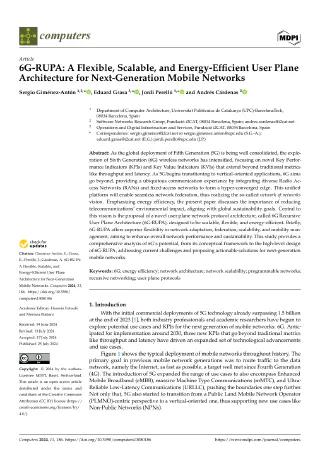
Our position paper introducing 6G-RUPA has been published and selected as the journal cover.
Publications
Articles
Follow a ping through the layers
One ping, box by box, first inside one operator and then across two. In each box the packet climbs only as far as the first envelope that isn't addressed to it, and that's the one layer the box relays in.
5G already has layers. It just can't change their policies
Read as layers, the 5G user plane already has the shape 6G-RUPA builds on. Two things hold it back: a protocol split at the base station, and data transfer policies fixed by the standards.
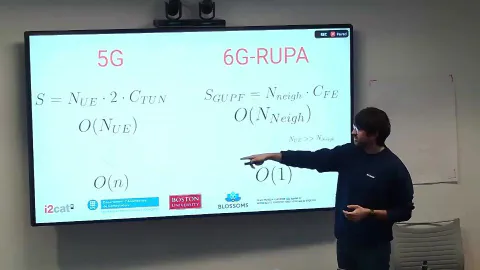
Why the 5G core needs more memory for every new user
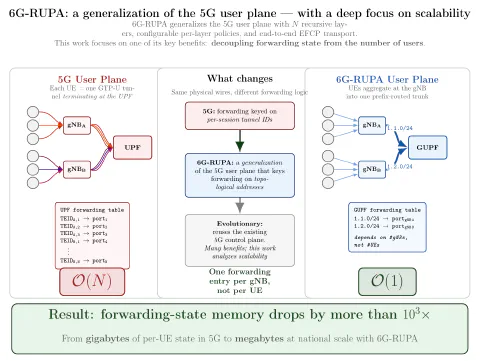
A 5G UPF keeps tunnel and forwarding state for every session it serves, so its tables grow with the number of users. 6G-RUPA forwards on addresses that name base stations instead, and the table stops caring how many phones sit behind them.